

Stop Treating LLMs Like Google (And How I Used One to Crack a “Forensic Mystery”)
We’ve all seen the complaints. “LLMs hallucinate.” “They get simple things wrong.” “They just regurgitate internet folklore.”
The Setup: The Impossible Drive
fdisk on a 2 GiB drive (/dev/sdb). The output was completely nonsensical: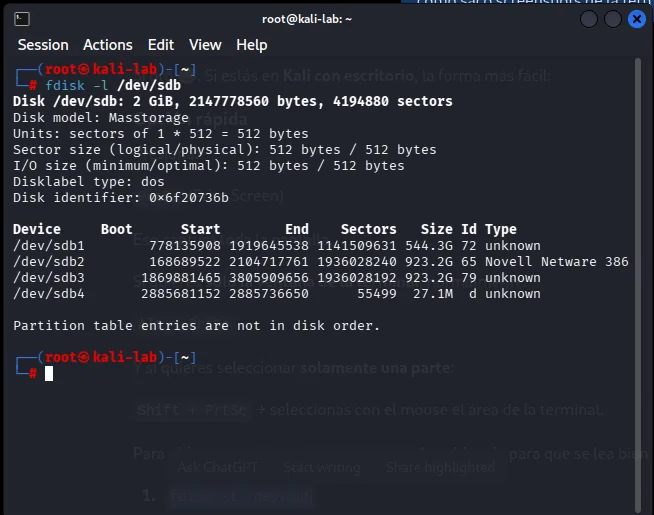
- The physical disk size was reported as 2 GiB.
- Yet,
fdisklisted individual partitions that were 544.3 GiB and 923.2 GiB in size. - The file system types were listed as ancient formats like “Novell Netware.”
This was the entire text that accompanied the screenshot: “Need forensic analysis of anomalous USB/MP3 behavior — looking for low-level explanation”.
6F20736B), you find the exact same ghost partition table popping up on tech forums dating back over a decade.The “Hammer” Theory
When I first dumped this problem into an LLM, it fell into the exact same trap. It scanned the internet, found the folklore about fake flash drives, and confidently parroted it back to me.
But something felt off. If it was random corruption or a faked firmware loop, why were the disk signatures and partition layouts exactly identical across different drives over a ten-year span?
“If you’re a hammer, everything becomes a nail.”
fdisk is a hammer. It expects a partition table at Sector 0, so it blindly maps whatever bytes are sitting there into its rigid fields. What if we weren’t looking at hardware corruption, but simply raw text being misread out of alignment? The Deep Dive: Reversing the Math
Instead of accepting the AI’s first answer, I challenged it. I realized that if fdisk was hallucinating a partition table out of raw data, we should be able to reverse-engineer the math. The partition table is a 4 * 16 bytes structure. We have decimal values for START and SECTORS, these are 4 byte values and the position (byte offset) is known. We have the partition IDs, those are already HEX values. HEX we can convert to ASCII.
I told the LLM to ignore the “fake drive” theory, take the massive decimal numbers from the terminal output (the start sectors and sizes), convert them back into Hex, and decode them into ASCII text using Little-Endian alignment. By forcing the AI to step away from “search engine” mode and into “data crunching” mode, the raw text unmasked itself:
| Partition | Field | Hex Value (Little-Endian) | ASCII String Conversion |
|---|---|---|---|
| Partition 1 | Start Sector | 64 69 61 2E |
dia. |
| Total Sectors | FF 0D 0A 44 |
\xff\r\nD (Newline + D) |
|
| Partition 2 | Type ID | 65 |
e (completes “Media”) |
| Start Sector | 20 72 0D 0A |
r\r\n (Space + r + Newline) |
|
| Total Sectors | 54 72 65 53 |
Pres |
|
| Partition 3 | Type ID | 79 |
y (completes “Press”) |
| Start Sector | 6F 74 20 6F |
o to |
|
| Total Sectors | 20 72 65 73 |
res |
The Solution
- …media…
- …Pres…
- …y to res…
dd and accidentally burned a standard Volume Boot Record (VBR) directly onto LBA 0 (the Master Boot Record boundary). Because the legacy error text happened to align perfectly with the partition table structural offsets, fdisk read plain English characters as massive sector boundaries. If you look at the sector in HEX, you’d immediately see it.The Real Takeaway
The breakthrough came from the feedback loop. When you treat an LLM as a collaborative peer (challenging its assumptions, feeding it new hypotheses, and directing its computational strengths) you can unmask anomalies that both humans and algorithms miss when working alone.